
Dynamics of the Chicago Fine Dining Ecosystem: Reservation Volume, Platform Stratification, and Market Performance on OpenTable
The following report provides an exhaustive, data-dense analysis of the top-performing Chicago restaurants identified in OpenTable's most recent Top 100 national data, highly booked fine dining establishments utilizing the platform, and the broader technological, macroeconomic, and operational dynamics shaping the Chicago reservation landscape. Extensive findings regarding high-volume establishments, along with their digital footprints, have been synthesized to fulfill the core intent of the inquiry.
The Chicago Hegemony in the National Reservation Landscape
The Chicago fine dining market exhibits extraordinary density and outsized performance on a national scale, fundamentally acting as a bellwether for the broader United States hospitality industry. In the 2025 OpenTable Top 100 Restaurants in America list—a definitive industry benchmark culled from over 12 million verified diner reviews, reservation percentages made in advance, and five-star rating volumes—Chicago claimed a staggering 16% of all honorees across the 42 cities represented1. This absolute dominance indicates not only a highly engaged local dining populace but also a thriving culinary tourism sector capable of sustaining immense volume across varying price points and neighborhood geographies.
The sixteen Chicago restaurants that secured a position on this elite national list represent a profound cross-section of the city’s culinary diversity. The data indicates a distinct migration away from a monolithic reliance on the traditional midwestern steakhouse and a heavy pivot toward contemporary, ingredient-driven, and globally inspired concepts2. The recognized establishments include high-velocity neighborhood concepts such as Akahoshi Ramen and Daisies in Logan Square, which leverage OpenTable to manage relentless demand for elevated comfort fare2. The West Loop, arguably the epicenter of Chicago's gastronomic boom, is represented by Alla Vita and Rose Mary, both of which command intense reservation velocity for their respective Italian and Italian-Croatian menus3.
Legacy neighborhoods like River North and Streeterville remain vital anchors for institutional wealth and corporate dining, represented on the volume list by Gibsons Italia, Joe's Seafood, Prime Steak & Stone Crab, Le Colonial, and RL Restaurant2. Establishments such as Mon Ami Gabi and North Pond in Lincoln Park continue to demonstrate that classic French and farm-to-table American concepts, when executed with high consistency, can maintain top-tier volume over decades3. Further emphasizing the city's diverse palate, Noriko, Pizz'amici, Pizzeria Portofino, Topo Gigio, and Valhalla round out the OpenTable Top 100, proving that highly optimized reservation systems are critical whether a restaurant is serving meticulously crafted sushi, wood-fired pizza, or avant-garde tasting menus2.
These establishments all secured exceptional aggregate ratings, frequently holding steady at 4.8 out of 5.0 across thousands of verified reviews, demonstrating that high reservation volume does not necessitate a degradation in guest experience4.
The Unit Economics of Restaurant Reservations and Platform Stratification
To understand why these elite restaurants utilize OpenTable, one must thoroughly analyze the platform's underlying financial architecture and its role as a primary customer acquisition engine. The digital reservation marketplace in the United States is highly stratified, effectively operating as an aggressive duopoly between OpenTable (owned by Booking Holdings) and Resy (owned by American Express), with Tock (also acquired by American Express for $400 million) occupying a lucrative niche for prepaid, high-friction tasting menus9. OpenTable remains the dominant incumbent, holding approximately 46% of the U.S. market share and servicing roughly 60,000 restaurants globally10. For Chicago restaurateurs, the decision to list on OpenTable is fundamentally a complex calculation of Customer Acquisition Cost versus total cover volume.
OpenTable's pricing structure is bifurcated into a fixed monthly subscription and variable transaction fees, which drastically alter profit margins as a restaurant's volume increases. The platform offers three primary tiers: Basic ($149 per month), Core ($299 per month), and Pro ($499 per month)12. The critical variable for operators is the per-cover fee, which applies to any reservation generated through OpenTable's discovery network, meaning any diner who finds the restaurant via the OpenTable app or website14. This fee ranges from $1.00 to $1.50 per seated diner, with the Basic plan charging the higher $1.50 rate and introducing a punitive $0.25 fee even for reservations made through the restaurant's own website13. Furthermore, OpenTable recently instituted a 2% service fee on financial transactions, such as prepaid experiences or reservation deposits13.
The compounding nature of these fees requires rigorous financial modeling from Chicago operators. For a high-volume venue seating 100 covers a night (amounting to 2,500 covers a month), the financial burden scales aggressively. If a standard 60% of those reservations (1,500 covers) originate from the OpenTable network, the monthly expense on the mid-tier Core plan calculates to a $299 base subscription plus $1,500 in network fees, totaling $1,799 per month, or nearly $21,600 annually13. For establishments offering high-priced tasting menus moving $30,000 a month in prepaid inventory, the additional 2% service fee pushes the platform cost to roughly $2,400 per month13. In stark contrast, competing platforms like Resy or Eat App rely on flat-fee Software as a Service models, ranging from $229 to $899 per month, without penalizing the operator for high reservation volume9.
Despite the profound mathematical friction of per-cover fees, major Chicago hospitality groups remain anchored to OpenTable because it functions as an unparalleled marketing and customer acquisition engine11. OpenTable claims a 4:1 return on investment, asserting that $4 is generated for every $1 spent by the restaurant on network fees12. For operators who lack the innate brand gravity to fill their dining rooms entirely through direct, organic traffic, OpenTable acts as the digital front door, aggregating demand from international tourists, domestic business travelers, and spontaneous local diners who utilize the app as a primary search engine15. The platform's internal loyalty program, which allows diners to convert booking points into dining rewards, further entrenches consumer reliance on the OpenTable ecosystem, creating a cyclical demand loop that restaurants abandon at their own peril18.
Market Segmentation: The Defectors and the Loyalists
The Chicago market demonstrates a clear bifurcation in platform adoption based entirely on the operational nature of the dining experience, separating high-friction pre-paid models from high-volume discovery models.
The High-Friction, Pre-Paid Tier (The Tock Migration)
Ultra-fine dining establishments specializing in multi-course, pre-fixe tasting menus have largely migrated away from the traditional OpenTable model toward Tock, a platform originally founded in Chicago specifically to solve the inefficiencies of high-end ticketing18. Establishments such as Ever, Oriole, Kasama, Smyth, and Schwa require upfront financial commitments, often selling non-refundable tickets rather than taking traditional reservations5. This architectural shift essentially eliminates the financial devastation of no-shows—a critical protective measure for restaurants operating with razor-thin margins and highly perishable, meticulously sourced inventory. Tock’s model, which frequently charges a percentage fee on prepaid bookings rather than a per-cover network fee, aligns perfectly with venues where scarcity, rather than discovery, drives demand9.
Interestingly, Alinea—arguably Chicago’s most famous modernist restaurant and one of only fourteen in the United States to hold a three-Michelin-star rating—utilizes a highly sophisticated hybrid strategy. While traditionally anchored to Tock for its primary Gallery and Kitchen Table ticketing, Alinea actively utilizes OpenTable to manage inventory for specific future months or distinct dining room experiences22. By leveraging OpenTable for specific release windows, Alinea taps into the platform's immense global reach when its yield management algorithms determine that a wider funnel is necessary to maintain absolute capacity22.
The Volume and Discovery Tier (The OpenTable Loyalists)
Restaurants designed for high turnover, corporate expense accounts, and large group dining remain fiercely loyal to OpenTable. A prime example is The Gage, located steps from Millennium Park on South Michigan Avenue. Describing itself as one of Chicago's most booked restaurants, The Gage utilizes OpenTable to capture the massive influx of tourists, convention-goers, and local professionals seeking elevated rustic American fare24. The constant flow of discovery traffic justifies the per-cover fees, as these diners might otherwise walk into a competing venue along the highly competitive Michigan Avenue corridor.
Similarly, massive hospitality conglomerates dominating the Chicago landscape utilize OpenTable to cross-pollinate their audiences and manage sprawling portfolios. Lettuce Entertain You Enterprises (LEYE), a foundational pillar of Chicago dining since 1971, relies on OpenTable for a vast portfolio of concepts, ranging from the classic French bistro Mon Ami Gabi in Lincoln Park to modern, high-energy venues like Sushi-san and the newly opened Tuscan steakhouse Tre Dita at the St. Regis Chicago7. For instance, Aba, a Mediterranean rooftop concept in the Fulton Market district, routinely experiences extreme peak demand during the summer months and golden hour27. OpenTable manages this extreme velocity, funneling diners into early (5:30 PM) or late (9:30 PM) seatings when prime 7:00 PM slots are exhausted, thereby maximizing the total daily revenue yield27.
Boka Restaurant Group, another dominant force managing Michelin-starred venues like Boka alongside high-energy environments such as Girl & The Goat, Momotaro, and Alla Vita, also relies heavily on OpenTable's infrastructure29. OpenTable's capacity to handle granular inventory management is vital for concepts like Girl & The Goat, which commands relentless global demand, and Momotaro, which must dynamically coordinate seating across an expansive multi-level Izakaya space in the West Loop30.
Mitigating Revenue Leakage: The Calculus of No-Shows and Platform Safeguards
Reservation platforms are not merely passive booking engines; they are active revenue protection systems. In the fine dining sector, an empty table is a highly perishable commodity with a strictly limited lifespan. The economic ramifications of no-shows are devastating to operational stability.
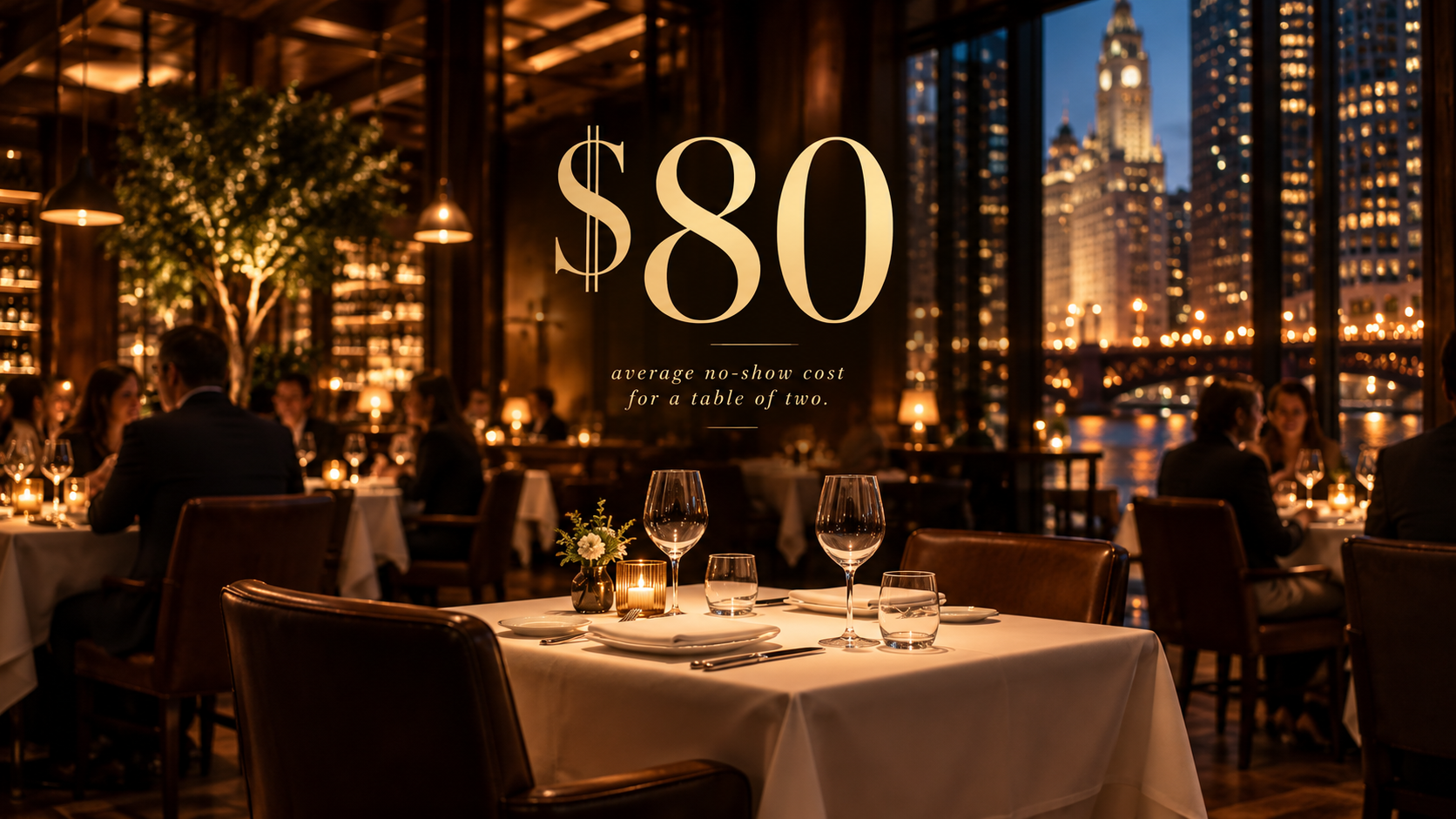
According to inaugural impact data from OpenTable, the average cost to a restaurant operator for a no-show table for two is $8032. When factoring in the operational ripple effects, 56% of restaurant workers report that a no-show directly forces them to turn away other paying guests, 51% cite unrecoverable labor costs because staff are scheduled based on projected covers, and 49% cite the immediate wasting of perishable food stock32. Compounding this issue, historical data indicates that upwards of 28% of Americans have made a reservation and failed to honor the booking33.
To combat this revenue leakage, Chicago's fine dining venues have weaponized OpenTable's credit card hold features. The standard operational protocol now involves securing a credit card at the time of booking, with cancellation fees in the city typically ranging from $10 to $50 per person, heavily dependent on the restaurant's market positioning33. Geja's Cafe, a historic fondue establishment in Lincoln Park frequently lauded as one of the city's most romantic restaurants, strictly enforces a $25 per person fee for no-shows34. Because their dining model involves highly specific preparation for multi-course fondue experiences—such as the Prince Geja's combination featuring beef tenderloin, lobster tail, and scallops—late cancellations result in immediate, unrecoverable food waste36.
The implementation of these fees serves as a psychological and behavioral deterrent. Data indicates that when diners are subjected to financial penalties, cancellation behaviors radically shift, encouraging guests to cancel well in advance33. This advance notice allows OpenTable's waitlist recovery algorithms (notifying the next diner in line via automated SMS) to function effectively, saving the cover and protecting the restaurant's daily revenue yield37.
Macroeconomic Headwinds: The Compression of the Chicago Margin
The reliance on advanced reservation technology to optimize dining rooms is increasingly urgent due to intense macroeconomic pressures unique to the Chicago regulatory environment. Profit margins, historically slim in the hospitality sector, are facing unprecedented compression.
In May 2026, the Chicago City Council moved to pause the planned phaseout of the tip credit for tipped workers under the "One Fair Wage" ordinance, delaying the ultimate elimination of the subminimum tipped wage by two years until 2028 or later, depending on employer size38. However, this pause provided only temporary relief, as the baseline tipped minimum wage still increased significantly to $12.96 per hour39. Crucially, if a server's wages plus tips do not equal the full standard minimum wage in effect, the restaurant operator is legally mandated to make up the difference39.
This localized labor cost escalation compounds with Chicago's notoriously high compound restaurant tax, which can reach up to 11.75% when incorporating state, city, specific restaurant, and Cook County levies40. When a fine dining establishment is simultaneously absorbing a $12.96 base hourly wage per front-of-house employee, navigating an 11.75% combined tax rate, and surrendering $1.00 to $1.50 to OpenTable for every seated network diner, the unit economics of a single plate of food are severely compromised13.
In response to these compounding liabilities, Chicago restaurants have adopted aggressive alternative pricing models. The implementation of 3% to 5% "cost of doing business" surcharges on final bills has become ubiquitous, particularly in high-rent districts like the West Loop and River North41. Operators utilize these opaque surcharges to quietly offset back-of-house labor increases and software platform fees without raising the printed menu prices to points that might trigger immediate demand destruction from price-sensitive consumers41. Reservation platforms are critical in this tight-margin environment; optimizing table turns via OpenTable's Smart Assign algorithms ensures the absolute maximum amount of revenue is extracted per square foot of dining room space during the highly lucrative 5:00 PM to 10:00 PM revenue window9.
The Credit Card Loyalty Wars: Chase vs. American Express
A critical, often overlooked dimension of the Chicago reservation market is the proxy war being waged by major financial institutions, using dining platforms as their primary battleground for high-net-worth customer acquisition.
American Express explicitly acquired Resy and Tock to offer its premium Platinum and Centurion cardholders exclusive access to highly coveted dining inventory, recognizing that access to impossible reservations is a powerful driver of credit card loyalty9. In a direct, aggressive counter-maneuver, Chase integrated deeply with OpenTable to launch the "Sapphire Reserve Exclusive Tables" program through the broader Visa Dining Collection43.
In the Chicago market, the Chase Sapphire Reserve program exerts significant influence over luxury dining behaviors. Cardmembers receive a $300 annual dining credit and gain digital access to prime-time reservation slots (typically 7:00 PM to 8:00 PM on Fridays and Saturdays) that are shielded entirely from the general public on OpenTable43. As of late 2026, 27 elite Chicago restaurants participate in this exclusive OpenTable ecosystem43. The strategic alignments include:
- Chicago Cut Steakhouse: A high-volume riverside steakhouse where average per-person checks easily exceed $150. This price point allows cardholders to instantly liquidate their semiannual $150 dining credits in a single transaction, making it a highly desirable booking for Reserve members43.
- Momotaro: The Boka Restaurant Group's West Loop Japanese flagship, where the $80 average per-person cost perfectly aligns with luxury dining subsidies, driving consistent, high-value foot traffic to the venue43.
- Sepia: A Michelin-starred, ingredient-driven American concept located in a 19th-century print shop in the West Loop. The tasting menu experience commands approximately $140 per person, fitting perfectly within the parameters of the Chase subsidy21.
By gating premium inventory for Chase cardholders, OpenTable provides these Chicago operators with a guaranteed pipeline of high-spend, low-attrition diners44. This strategic financial alliance is one of OpenTable's most robust defenses against Resy's encroachment in the upscale urban market, ensuring that top-tier Chicago restaurants remain incentivized to utilize OpenTable's software.
Segment Analysis: The Evolution of the Chicago Fine Dining Menu
A thorough review of Chicago’s top OpenTable performers reveals distinct sub-segments within the fine dining ecosystem, each leveraging the platform's diverse feature set to cater to specific consumer demographics.
The Institutional Steakhouses
Chicago’s culinary identity remains inextricably linked to the American steakhouse, and these venues process massive reservation volumes on OpenTable, relying on the platform's ability to manage complex, multi-room floor plans.
- Gene & Georgetti: Operating continuously since 1941, this is Chicago's original Tuscan steakhouse located in River North46. Managing an intense volume of multi-generational regulars and eager tourists drawn to its history as Al Capone's alleged favorite restaurant, the venue requires a platform that easily accommodates its extensive menu of dry-aged T-Bones, classic Chicken Joe, and colossal seafood towers47.
- Chicago Chop House: Housed in a meticulously restored 130-year-old Victorian brownstone in River North, this venue relies heavily on OpenTable and Tock to process reservations for its highly sought-after upper-level dining room. Here, guests consume premium cuts of beef while surrounded by over 1,400 historical photos documenting Chicago's meatpacking and political history49.
- Corporate Powerhouses: National luxury chains operate multiple high-volume outposts across the Chicago area. Morton's The Steakhouse (with prominent locations at Wacker Place and in suburban Schaumburg) manages an expansive dining room catering heavily to the Loop's business elite and convention traffic52. Similarly, The Capital Grille on the Magnificent Mile orchestrates high-end retail tourism dining54. OpenTable provides the enterprise-grade CRM infrastructure necessary to track the preferences and spending habits of these lucrative corporate accounts across multiple geographical locations.
The Contemporary American and European Vanguard
Beyond the traditional red meat sector, the city's highest-rated OpenTable venues focus on hyper-seasonal, globally influenced cuisine requiring delicate execution and precise pacing.
- Bistronomic: Located in the affluent Gold Coast neighborhood, Executive Chef Martial Noguier utilizes OpenTable to ensure consistent utilization of his modern French bistro. The restaurant successfully balances an approachable economic price point with Michelin Bib Gourmand-level culinary execution55.
- Sepia: Executive Chef Andrew Zimmerman expertly blends Southeast Asian, Korean, and Mediterranean influences with classical American cooking21. Because Sepia strictly limits its OpenTable booking window to open exactly 60 days in advance, demand is highly compressed, requiring robust backend software architecture to manage the sudden influx of digital traffic without crashing21.
- Monteverde: Chef Sarah Grueneberg’s West Loop Italian flagship remains one of the most difficult reservations to secure in the city20. By blending traditional Italian techniques with global influences—anchored visually and culinarily by a working, in-house pastificio—Monteverde sustains relentless, year-round demand. The restaurant relies on OpenTable's advanced waitlist and notification features to manage its deeply congested digital queue57.
- Cindy's Rooftop: Operating atop the historic Chicago Athletic Association, Cindy's pairs seasonal cuisine (ranging from East Coast Oysters to elaborate Duck Pot Pies) with panoramic, highly photogenic views of Millennium Park and Lake Michigan59. The intense, casual-to-fine-dining volume generated by the unparalleled view requires OpenTable to strictly regulate table turn times, preventing dangerous bottlenecking at the hotel elevators and ground-floor host stands.
Comprehensive Directory of Premier Chicago Fine Dining Establishments on OpenTable
The following table aggregates an exhaustive list of the preeminent fine dining, upscale, and high-volume establishments in the Chicago area that actively utilize OpenTable for reservation management, reflecting the diverse culinary landscape demanded by the user's inquiry. The data has been synthesized from OpenTable's Top 100 lists, Michelin Guide partnerships, and Chase Sapphire Exclusive rosters2.
| Restaurant Name | Neighborhood / Location | Primary Cuisine |
|---|---|---|
| Aba | Fulton Market | Mediterranean / Middle Eastern |
| Alinea (Select Dates/Rooms) | Lincoln Park | Modernist / Contemporary |
| Alla Vita | West Loop | Italian |
| Bavette's Bar & Boeuf | River North | French Steakhouse |
| Boka | Lincoln Park | Seasonal American |
| Chicago Cut Steakhouse | River North | Steakhouse |
| Cindy's Rooftop | Downtown (Millennium Park) | Contemporary American |
| The Gage | The Loop | Rustic American / Gastropub |
| Geja's Cafe | Lincoln Park | Fondue / Romantic |
| Gibsons Italia | Fulton River District | Italian / Steakhouse |
| Girl & the Goat | West Loop | Contemporary Global |
| Momotaro | West Loop | Japanese Izakaya |
| Monteverde | West Loop | Contemporary Italian |
| Sepia | West Loop | Contemporary American |
(Note: The hospitality industry is highly fluid. While some establishments like Remington's and certain Lettuce Entertain You properties actively experiment with competitors like Tock or Resy to mitigate per-cover fees, their massive historical footprint on OpenTable cements their legacy in the platform's data ecosystem61.)
Strategic Conclusion
The Chicago fine dining sector operates within a highly complex, technologically mediated environment. OpenTable is no longer merely a digital host stand; it is a critical macroeconomic lever. As restaurants face the compounded financial pressures of the One Fair Wage ordinance, escalating local taxation, and exorbitant real estate costs in neighborhoods like the West Loop, the mathematical reality of a $1.00 to $1.50 per-cover customer acquisition fee forces a strategic reckoning for every operator in the city12.
However, Chicago's outsized dominance on the OpenTable Top 100 list—comprising 16% of the nation's most elite, highly rated reservations—proves that for the vast majority of premium operators, the platform's unrivaled discovery engine, behavioral guardrails against no-shows, and strategic corporate partnerships (such as the Chase Sapphire Reserve network) thoroughly justify the expense2. Until a competing software provider can replicate OpenTable's ability to seamlessly aggregate high-net-worth tourists, corporate clients, and discerning locals into a single, reliable digital funnel, it will remain the indispensable circulatory system for Chicago's world-class dining economy.
Works cited
- Chicago is home to Six of the top 100 restaurants in the U.S. - Reddit, Link
- OpenTable Announces the 2025 Top 100 Restaurants in America, Link
- These Chicago Spots Are Among OpenTable's Top 100 Restaurants, Link
- These Chicago Restaurants Landed on OpenTable's Top 100 List, Link
- Chicago MICHELIN Restaurants - The MICHELIN Guide, Link
- OpenTable vs. Resy: Which Reservation System Should You Pay, Link
- OpenTable Pricing in 2026: Plans, Fees and Real Costs - Eat App, Link
- Sepia, Chicago — Table Availability & Cancellations, Link
- Alinea Restaurant, Link